
Tax-Loss Harvesting with Daily-Liquid Bond Funds
By Sardis Group
Key Points
- For daily-liquid bond funds, price return drives NAV performance, because coupon income is paid out to shareholders. Most major Bloomberg bond indices are negative on the year from a price perspective.
- That makes daily-liquid bond funds natural candidates for harvesting losses before year-end.
- SGSIX offers a differentiated home for the proceeds: high current income, a quarterly repurchase structure that keeps the portfolio out of the daily redemption cycle (and limits investor liquidity), and a differentiated portfolio which may help address the wash-sale question.
A Difficult Year for Bonds
Bonds have had a tough 2026. Inflation has run hotter than expected, crude prices have surged, deficit concerns persist, and a resilient economy has given Fed Chair Warsh room to tighten. The first-half selloff accelerated in September: the Fed delivered its first rate hike since July 2023, a hawkish dot plot pushed front-end yields higher, and a post-summer surge in issuance, much of it tied to data center and AI financing, cheapened the belly of the curve. At the long end, deficit fears and consistently strong economic data have pushed the 10-year yield to its highest level since before the Global Financial Crisis.
Year-to-Date Total Return Comparison
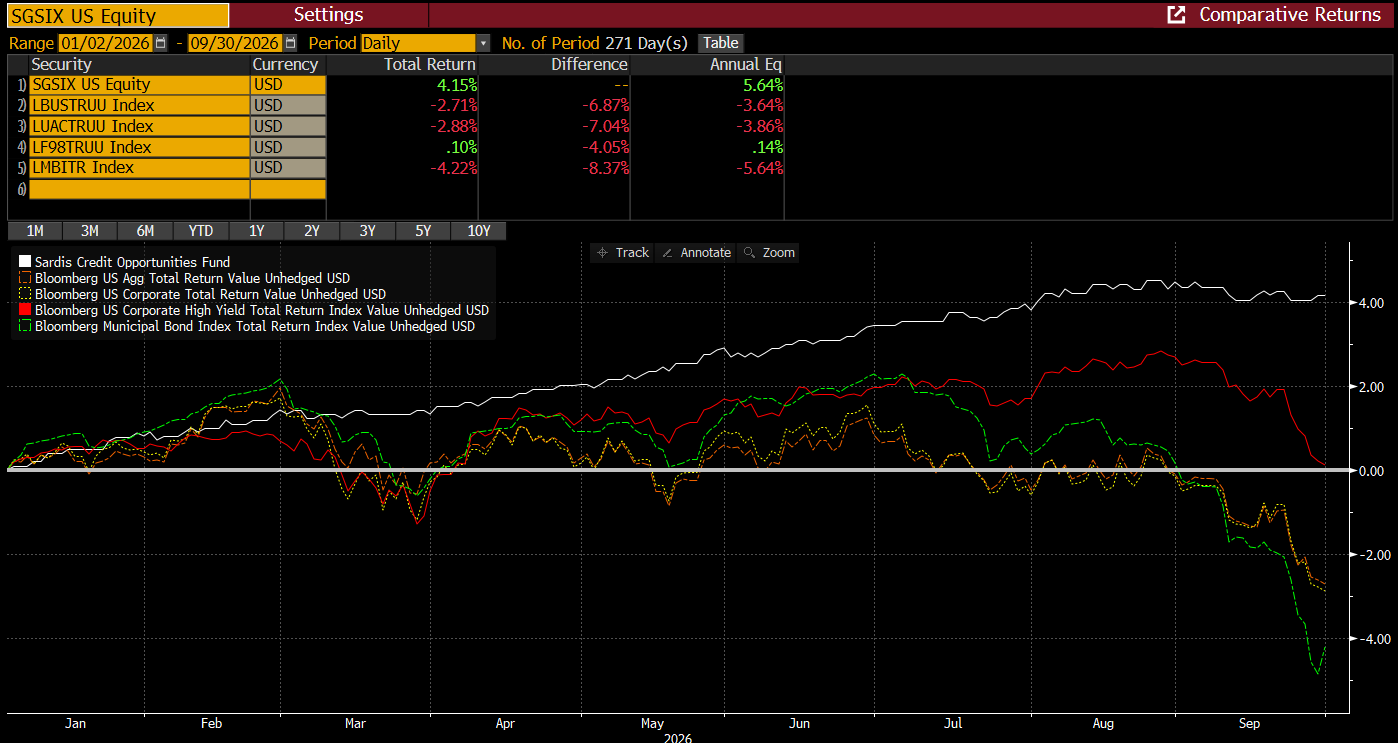
Source: Bloomberg, 1/2/2026 to 9/30/2026. SGSIX returns are for Class I shares, net of fees and expenses, and assume reinvestment of distributions. Past performance does not guarantee future results. Indices are unmanaged, do not reflect fees or expenses, and cannot be invested in directly.
On a total return basis, the aggregate, investment grade and municipal indices have turned sharply negative since the end of August, while high yield remains slightly positive. Total return, however, tells only part of the story.
Price Return Is What Fund Investors Actually Feel
Index returns are quoted on a total return basis, which assumes coupon income is reinvested. Daily-liquid bond funds typically distribute coupon income to shareholders, so income leaves the fund rather than building up in the NAV. What stays in the NAV is price return. An investor who bought at the start of the year has collected income along the way, but their shares are worth less than they paid, and that gap is a harvestable loss.
Year-to-Date Return Decomposition
| Fund / Index | Total Return | Price Return | Coupon Return |
|---|---|---|---|
| SGSIX (Sardis Credit Opportunities Fund) | 4.15% | ‑2.05% | 6.20% |
| US Aggregate (LBUSTRUU) | ‑2.71% | ‑5.77% | 3.06% |
| US Corporate IG (LUACTRUU) | ‑2.88% | ‑6.44% | 3.56% |
| US Corporate High Yield (LF98TRUU) | 0.10% | ‑4.69% | 4.79% |
| Municipal Bond (LMBITR) | ‑4.22% | ‑7.94% | 3.72% |
Source: Bloomberg, 1/2/2026 to 9/30/2026. SGSIX returns are for Class I shares, are net of fees and expenses, and assume reinvestment of dividends. For SGSIX, price return is the change in net asset value and coupon return is the return from distributions paid during the period. Without the Adviser’s expense limitation agreement, SGSIX returns would have been lower. For the indices, coupon return is Bloomberg’s “coupon return” component. Components may not sum exactly due to compounding and, for the Aggregate Index, paydown return. Indices are unmanaged, do not reflect fees or expenses, and cannot be invested in directly. None of the indices shown is a securitized credit index. The Fund invests mainly in asset-backed, residential mortgage-backed and commercial mortgage-backed securities and loans, may invest without limit in below investment grade and unrated securities, and may use leverage; its income and risk differ from those of the indices. Past performance does not guarantee future results, and current performance may be lower or higher than the performance shown.
All four indices are negative on a price basis, ranging from ‑4.69% for high yield to ‑7.94% for municipals. High yield makes the point most clearly. Its total return is a positive 0.10%, yet its price return is ‑4.69%, so a high yield fund holder is likely sitting on an unrealized loss, because the income was paid out while prices fell. With the 10-year yield at its highest level since before the GFC, even lots purchased in 2022 through 2025 are likely underwater on a price basis. We believe many losses from 2020 and 2021 purchases were harvested in 2022 and 2023 and that today’s opportunity is mainly in positions bought since. These indices are not directly investable and do not reflect fees or expenses. They illustrate market conditions; daily-liquid bond funds with similar holdings will have different returns.
The Case for Harvesting Before Year-End
Realizing these losses can turn a difficult year into a tax asset. The benefits generally include:
- Offsetting capital gains. After several years of strong equity returns, many portfolios are overweight stocks. Bond losses harvested now can offset the gains realized in trimming those positions, letting advisors move allocations back to target with a smaller tax bill.
- Offsetting ordinary income. Up to $3,000 per year can be applied once gains are used up, with unused losses carried forward indefinitely.
- Balancing the tax on distributions. Investors in taxable bond funds owe tax on coupon distributions each year, even when the NAV has fallen. Harvesting the price loss helps offset that bill.
- Repositioning without leaving the market. Proceeds can be reinvested right away, so the allocation can stay within fixed income with better entry points.
The wash-sale rule disallows a loss if the investor buys a “substantially identical” security within 30 days before or after the sale. Swapping one core bond index fund for another can invite that question. Reallocating to a differentiated, actively managed credit strategy such as SGSIX may give advisors a cleaner path to realizing the loss while keeping clients invested. Whether two securities are substantially identical depends on the facts. Sardis does not provide tax advice; investors should consult their tax advisors about their own situations.
The Hidden Cost of Staying Put
If harvesting picks up in the fourth quarter, those who stay in daily-liquid funds may bear the cost. Large redemptions can force managers to sell bonds to raise cash, sometimes into wider bid-ask spreads and thinner dealer liquidity. The resulting transaction costs and price concessions fall on the shareholders who remain, and the fund’s returns can become driven more by flows and execution than by credit fundamentals. In our view, that pressure is often greatest in December, when tax-loss selling and year-end distributions collide with thin holiday liquidity. Acting earlier in the quarter may avoid the most crowded window.
Why SGSIX
- Outside the daily redemption cycle. As an interval fund, SGSIX provides liquidity through quarterly repurchase offers of at least 5% of outstanding shares rather than daily redemptions. Because the timing and maximum size of each repurchase are known in advance, the portfolio is less likely to have to raise cash into weak markets, so positions can be held or added on fundamentals rather than sold on technicals.
- Higher current income. SGSIX’s annualized distribution rate is 8.44% and its SEC 30-day yield is 6.70% (5.27% unsubsidized) as of 9/30/2026. Year-to-date, income return has been 6.20%, compared with 3.06% to 4.79% for the indices shown. Distributions are not guaranteed.
- A buyer in the dislocation. In our view, higher benchmark yields and pockets of spread widening are creating entry points we have not seen since the 2022 bond bear market. Since SGSIX is not managing daily outflows, it can deploy capital into that weakness. We see attractive relative value and historically high current yields across consumer ABS and selectively in RMBS and CMBS.
- The trade-off is liquidity and credit risk. Interval fund shareholders can sell only through quarterly repurchase offers of at least 5% of outstanding shares, which are prorated if oversubscribed, so shareholders may not be able to sell all the shares they want in a given quarter. There is no secondary market for shares. The Fund may invest without limit in below investment grade and unrated securities, concentrates in mortgage-related and consumer loan securities, and may use leverage, which can magnify losses. SGSIX fits the portion of a fixed income allocation that does not need daily liquidity.
Bottom Line
2026 has left many bond fund investors with real, harvestable losses, even where headline total returns look modest. The size of that loss depends on where prices are on the day of sale; if rates rally, the opportunity shrinks, and it is likely to be widest before the December crowd arrives. For advisors who want to realize those losses without stepping out of fixed income, SGSIX offers high income, a structure designed to match the liquidity of its assets to the limited liquidity it offers shareholders, and room to take advantage of the current market volatility.
About the Firm
Sardis Group, LLC is an SEC-registered investment adviser headquartered in Atlanta, focused on structured credit. The firm manages the Sardis Credit Opportunities Fund (SGSIX), an interval fund investing in U.S. asset-backed, residential mortgage-backed, and commercial mortgage-backed securities and loans. For more information, visit www.sardisgroup.com or call 404-282-5552.
| Net Total Returns As of September 30, 2026 | QTD | YTD | Cumulative ITD (11/28/2025) |
|---|---|---|---|
| Sardis Credit Opportunities Fund (SGSIX) | 0.69% | 4.15% | 6.46% |
The performance data quoted represents past performance. Current performance may be lower or higher than the performance data quoted above. Past performance is no guarantee of future results. The investment return and principal value of an investment will fluctuate so that investor’s shares, when redeemed, may be worth more or less than their original cost. For performance information current to the most recent month-end, please call 404-282-5552.
Want to discuss?
Reach out to the team for additional commentary or to be added to our distribution list.
Contact Us Back to Insights